

Prayer

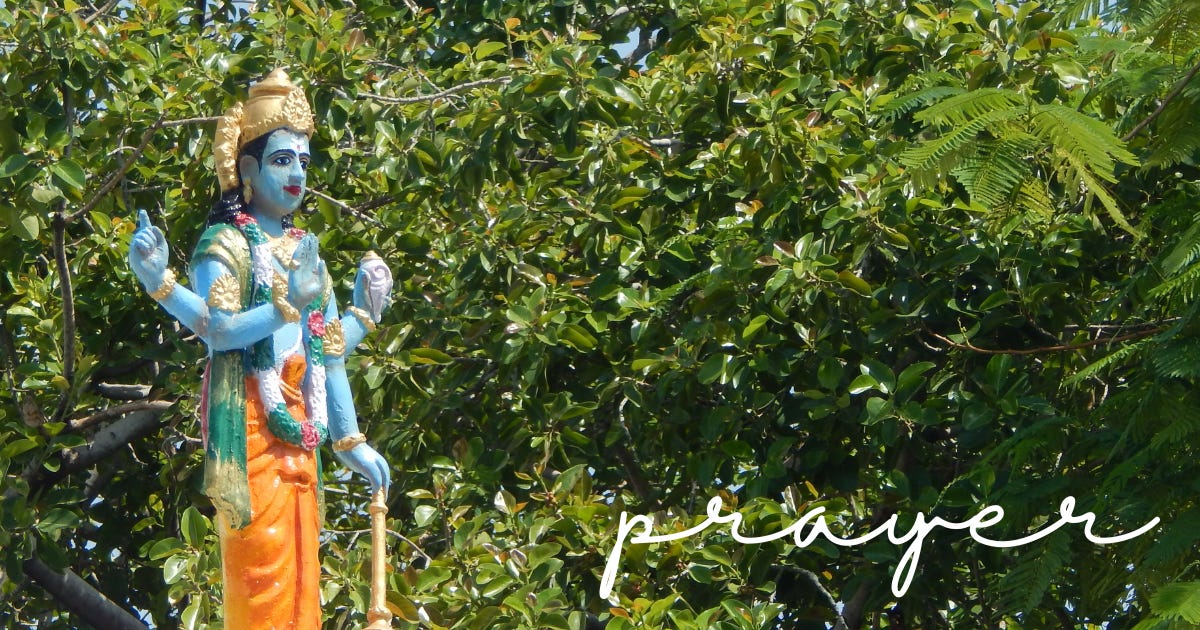
Last weekend, my cousin, who owns a hospital chain in India, told me he would spend two hours in prayer for a ceremony to move the Ganesh statue from one side of the hospital entrance to another. The priest had decided its current placement did not carry the right energy. The large Ganesha and its altar were relocated, followed by an elaborate prayer ceremony that lasted several hours each day over two days.
I couldn’t help wondering: how does he justify two hours in the middle of a life already too full? He was spending time he didn’t have, moving a statue originally placed there on a priest’s advice.
“Well, Usha,” he said gently, “I believe in cosmic power.” His words stayed with me.
I remembered a similar moment years ago, when my mother organized a massive prayer at our home because my husband was facing challenges in his company. I agreed quickly. Why not? It wasn’t harmful. It might even help. I had no evidence either way, but I wasn’t opposed. My husband, Diaz, a Christian with deep but quiet faith, agreed as well.
An hour into the prayers, he received a text: they had lost another major deal. I watched him absorb it. His face tightened, a flicker of lost composure, yet out of respect for my mom, the priests, and me, he stayed stoic. I felt a pang of sadness: did the prayer have any effect? Three years later, Diaz says that client loss triggered him to pivot the company into its current form, now in a hot space. Perhaps the prayer did help, just not in the way I had imagined.
Moments like these made me think of my own early experiences with faith, when belief felt absolute and unshakable. As a little girl, going to the temple was sacred family time. I was told I was deeply devoted. There are photographs: my hands folded neatly in namaste before Lord Ganesha; another of me in bright Indian clothes, watching as the priest bathed Lord Anjaneya in milk and honey. Faith then was a living, tangible presence.
As I grew older and moved to America, I carried Hinduism privately. Inside the house, it lived; outside, in my Western world, it receded. Hinduism was difficult to explain to friends and those I dated. There was no single book, no weekly sermon, no singular place or form of prayer. Even within the same religion, celebrations and rituals differed widely, and the idols of the same gods were made from different stones, carved differently, with subtle variations in expression and form. Scriptures were layered with interpretation, Sanskrit slokas recited more from tradition than comprehension.
When I moved to San Francisco and lived in a beautiful apartment overlooking the ocean in the Marina, I built a small altar. I prayed before exams, presentations, and interviews, negotiating with God to help me succeed, promising to fulfill my vows; whether donating to a cause, visiting a temple, or performing some other act of devotion. Later, in our home in Atherton, the altar grew into a bigger space, though tucked inside a closet in a spare bedroom, hidden from the mainstream of our lives. On Diwali, I insisted we gather before the altar to pray to Laxshmi, the goddess of wealth. I made prasad from milk, bananas, and honey, or cream of wheat with ghee and jaggery.
My parents, in contrast, had a full pooja room, with gods lining the walls, ancestors remembered, and incense lingering in the air. After retiring from his government job, my father spent hours in prayer and then reading and transcribing scriptures, translating Sanskrit into English so the philosophy would not be lost in ritual.
When my father passed away, I came to understand the intelligence of the religion in a way I hadn’t before. The ceremonies that followed, ten days of rituals immediately after his death, and monthly observances for a year, were designed not just for him, but for all of us. Their purpose was to release the body from the soul, allowing him to ascend to the heavens and be with his ancestors. And yet, they were also for the living: a structured way to grieve, to find peace, to honor a life well lived. In those rituals, I felt my Dad watching over us, guiding us quietly every day, even as we navigated ordinary challenges.
Lately, my WhatsApp fills with images of deities, messages about the 84 forms of Shiva, and invitations to all-night Shivratri celebrations. I scroll through them, feeling both fascination and distance. I pray to Lord Vishnu, as I was born a Vaishnavite, rather than to Lord Shiva, whom Shaivites worship. My devotion has always been quieter, something more personal, a different energy. Does that make my faith any less real, or is it simply a different lens through which to see the same mystery?
I find myself wondering what faith truly means to all of us who participate. Is it belonging, a way to connect to a larger community? Cultural identity, a thread tying us to ancestors and traditions we may not fully understand? A declaration that we are god-fearing, and therefore good? Or is it habit, repetition comforting us in its predictability? Or is it hope? Hope that some unseen order is at work, that we are not alone in our struggles?
What if it is something larger still: cosmic energy, quantum physics, or some force we have yet to explain. Something that moves through ritual and prayer, through devotion and intention, binding us to communities, to the larger world, and perhaps to ourselves.
When I think of my father’s faith, it was quieter, more interior, philosophical, and private. Diaz’s faith in Jesus Christ carries that same stillness. No performance. No transaction. Just orientation. Perhaps that is what bonded them so deeply despite their different religions: a shared surrender to something larger than themselves. Sometimes I wish I had that kind of inherent faith, the kind that steadies you, that insulates you during uncertainty.
I’m beginning to wonder if faith was never meant to bend outcomes at all. Maybe it isn’t about believing that rituals can alter events, but about trusting that we are not alone in uncertainty. Not that the universe will shift for us, but that something steadies us when it doesn’t. That kind of faith feels less like devotion to gods and more like a shift in perspective.
For a long time, I equated religion with ritual: the precise placement of a statue, the right chant, the proper clothes, the exact offering, the appointed priest, the designated hour. But beneath those details lies something more enduring: philosophy. A framework for navigating uncertainty. A discipline of gratitude when life resists our plans. A reminder to give thanks not only when things unfold in our favor, but simply because we are here: breathing, striving, connecting.
At its best, religion offers lessons for living. It teaches endurance with dignity and success with humility. When I was little, I heard numerous stories and parables, they seem to make complex truths accessible, stories of courage, pride, devotion, exile, forgiveness. I began to realize that perhaps rituals are really meant to preserve memory, anchoring us to our origins, while mythology reflects our nature back to us: flawed, conflicted, reaching.
Strip away superstition, and what remains is not fear but insight. Not transaction, but guidance. A way to remain steady when life falters, and to bow in gratitude when it flourishes.
I began to wonder if I could look at Hinduism through that lens! Not cosmic bargaining, but contemplation. Vedanta speaks of an underlying unity; a deeper intelligence that connects all things. Not a God who negotiates business deals, but a reality that asks us to surrender ego and trust the unfolding.
And Christianity, the faith that anchors my husband, speaks of something strikingly similar: surrender, humility, trust in a will larger than our own, strength through grace rather than control. Different languages. Different symbols. But the same posture: you are not sovereign over everything, yet you are not alone.
Perhaps what I am seeking now is not proof of divine intervention but permission: permission to believe that I am tied to something larger than myself. That there is order even when I cannot see it. Meaning even when I cannot measure it.
I don’t want blind faith. I want grounded faith. A practice that is intellectually honest yet emotionally supportive. A way to celebrate Diwali without superstition. A way to sit in church without contradiction. A way to honor my father’s Sanskrit translations and my husband’s quiet prayers without feeling divided between them.
I will continue with my prayers in front of the altar every morning, reciting them in Sanskrit while striving to understand their meaning; opening the day with hope and ending the evening with grace and gratitude. There is a large Indian community in the Bay Area, and perhaps I will begin by reconnecting culturally, maybe with the Tamil community, through festivals, shared meals, and celebrations. Not because I have resolved every theological question, but because belonging, too, is sacred.
And maybe, as my cousin said, there is something to the idea of cosmic energy. If you believe, perhaps it works for you, in ways you cannot always measure. My faith, then, may not be about bending the universe to my will, but about recognizing that some unseen current is moving through us, carrying intention, devotion, and connection. Maybe faith, for me, is less about certainty and more about choosing how I stand in uncertainty.
And maybe that is enough.